


Hey there! As a supplier of China Mechanical O Rings, I often get asked about all sorts of technical details. One question that pops up quite a bit is about the Poisson's ratio of our Mechanical O Rings. So, let's dig into what the Poisson's ratio is and how it relates to our products.
First off, what exactly is the Poisson's ratio? In simple terms, it's a measure of how a material behaves when it's stretched or compressed. When you pull on a material, it usually gets longer in the direction you're pulling (the axial direction), and at the same time, it gets thinner in the directions perpendicular to the pull (the transverse directions). The Poisson's ratio is the negative ratio of the transverse strain to the axial strain.
For example, if you have a rubber band and you stretch it, it gets longer but also narrower. The Poisson's ratio tells us how much narrower it gets relative to how much it gets longer. Most materials have a Poisson's ratio between 0 and 0.5. A value of 0 means the material doesn't change its width at all when stretched, while a value of 0.5 means the volume of the material remains constant during deformation.
Now, let's talk about our Mechanical O Ring. These O rings are made from high - quality rubber materials, and the Poisson's ratio plays a crucial role in their performance. When an O ring is compressed in a groove (which is how it's typically used for sealing purposes), the Poisson's ratio determines how it expands in the transverse directions.
A proper Poisson's ratio ensures that the O ring can effectively fill the space in the groove and create a tight seal. If the Poisson's ratio is too low, the O ring might not expand enough to seal properly, leading to leaks. On the other hand, if it's too high, the O ring might expand too much and cause excessive stress on the surrounding components, which could lead to premature failure.
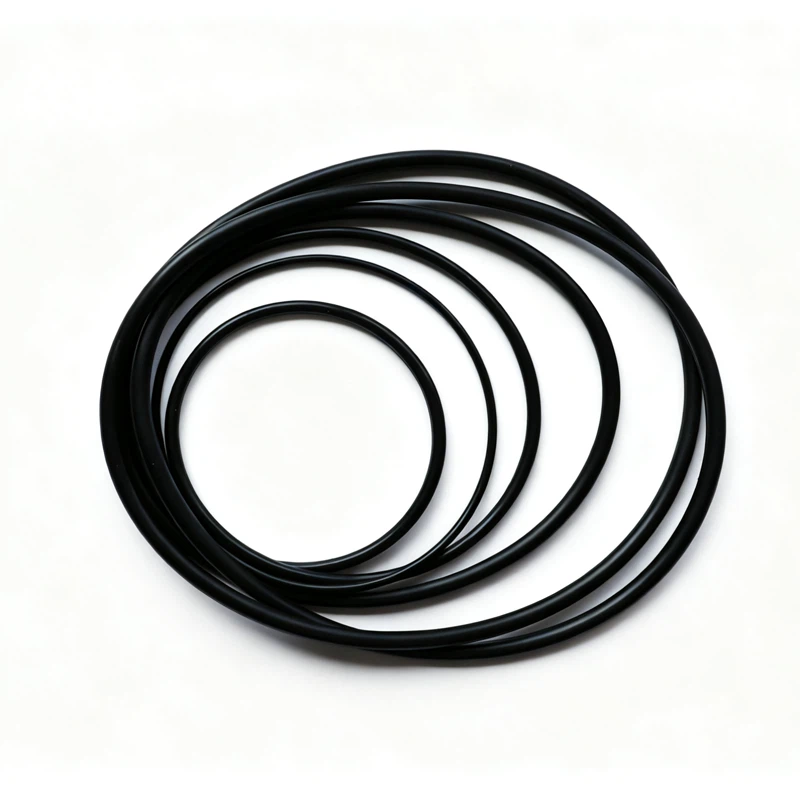

Our team of experts carefully selects the rubber compounds for our Mechanical O Rings to achieve an optimal Poisson's ratio. We test and analyze different materials to make sure they meet the requirements of various applications. Whether it's for high - pressure systems or low - temperature environments, we've got the right O ring with the right Poisson's ratio.
In addition to our Mechanical O Rings, we also offer Mechanical Insulating Rubber Strip and Oil Resistant Mechanical Gasket. The Poisson's ratio is also important for these products. For the insulating rubber strip, it affects how well it can conform to the surfaces it's sealing and maintain its insulating properties. For the oil - resistant gasket, it determines how it will perform under different pressures and temperatures while in contact with oil.
We understand that different industries have different needs when it comes to sealing solutions. That's why we're committed to providing high - quality products with the right technical specifications, including the Poisson's ratio. Our products are used in a wide range of applications, such as automotive, aerospace, and industrial machinery.
If you're in the market for reliable sealing products, we'd love to have a chat with you. Whether you need to know more about the Poisson's ratio or any other technical details, our team is here to help. We can work with you to find the perfect solution for your specific requirements. So, don't hesitate to reach out and start a conversation about your sealing needs.
References:
- "Mechanics of Materials" textbooks for general understanding of Poisson's ratio.
- Rubber material research papers for details on Poisson's ratio in rubber compounds.


